
Many people have heard of the New Age concepts of manifestation described in the book The Secret: you need to “ask,” “believe,” and then “receive.” In my experience, it’s not that simple. I feel that I have manifested my most heartfelt dreams in this lifetime, but for me the process was a bit different.
The formula I suggest involves these steps:
- Form a clear impression of your desire, not just visually, but viscerally. In other words, how will it feel when your dream is realized? Hold that feeling, steadily, for as long as it takes.
- Forgive everyone and everything that you feel might have wronged you in the past. Let it go. That includes acknowledging, and then forgiving yourself for things your less-aware and less wise self may have done.
- Live as though the dream is real, but just not here yet. You may need to, for example, make space (emotional as well as physical) for the thing (or partner) that hasn’t arrived yet, knowing its only a matter of time.
- Visualize the universe making the necessary arrangements (choreographing) the steps that will need to unfold in your future to bring about your vision. Be patient.
The way this worked for me, the feeling I have had, is that as soon as I have engaged in these steps, magical, mostly-unseen forces begin to work. They’re visible in the form of serendipity, or “meaningful coincidences.” I started to realize that random things that occurred may not be so random after all. I considered them to be like being lost in a cave and then noticing the crumbs on the ground I could follow to lead me out.
I realized that sometimes things that would come up in front of me seemed to be like a blockage in the path. Without thinking, I might have turned the other way or tried to find a way around, to avoid confrontation. But with the perspective that perhaps the appearance of this obstacle was no accident, and that I was being asked to go outside my comfort zone, I could choose again and accept the challenge. Invariably, I found this path to be rewarding. “What’s in the path, is the path.”
From the perspective of where I am now, I can’t tell whether I was able to manifest my most meaningful desires and dreams by using my consciousness and “laws of the universe,” or whether I already somehow intuitively knew the way this story ended, and I was just following an already-written script. I really don’t know.
Inner Work
A prerequisite, I think, is to do your “inner work.” The net result, if you’ve made sufficient progress, is that you’ll feel you are deserving of the experiences you desire. Until that work is done, the distractions of life can occupy your energy and disrupt the process.
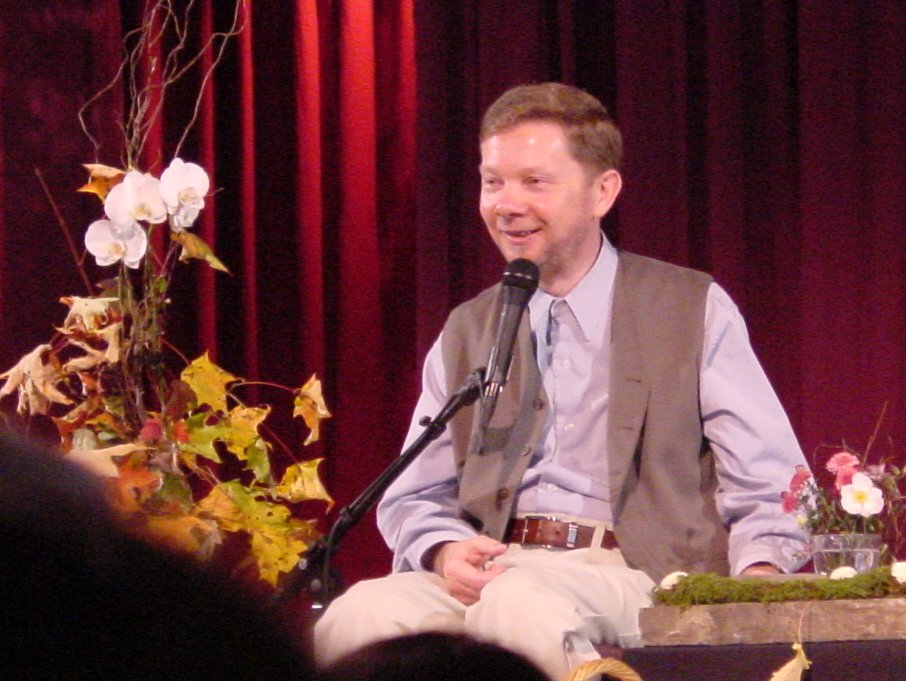
What is “inner work” then? I think Eckhart Tolle described it best when he talked of “pain bodies.” According to Tolle, a pain-body is a mass of negative energy that can occupy your body and mind. In his words, they’re “remnants of pain left behind by every strong negative emotion” you’ve experienced. He said they’re like parasites, living in you and feeding on you physically, mentally, and emotionally. The way I think of them is that they’re little programs in the subconscious mind that normally don’t do any harm, but that can be triggered into action by certain events or situations. Once triggered, emotions can take over, knocking you out of balance, creating emotional pain, and leading to unpleasant and unproductive interactions with the world and the people here in it. The inner work involves becoming aware of any pain bodies that might be lurking in your unconscious, and then healing them through various techniques, some as Tolle describes in his wonderful book The Power of Now.
Jack Dawes, writing at Inner Tradition describes his process:
This “emotional pain-body” renews and replenishes itself with every unconscious experience of further emotional pain, and deliberately generates negative emotions and thoughts to feed, grow and sustain itself. Tolle tells his readers to consciously observe the pain-body in action and disidentify from the influx of negative thoughts and emotions it produces; in this way it loses strength and can be “transmuted” by one’s “conscious presence”. The endgame is to dissolve it entirely by this method of detached conscious attention in the Now.
Projection
You may experience an unpleasant interaction with someone, where they accuse you of something. For example, they might claim you’re lazy, selfish, uncaring, or disrespectful. It’s possible they are projecting, which means that they’re attempting to see something in you that they feel subconsciously may be their own negative attribute. You can act as a “screen” upon which their projection can be seen outside themselves, and that way they can say “look, it’s not me, it’s you.” Projection can happen when a person is unable to accept that the source of the problem is him- or herself, and attempts to blame others.
My experience with projection led me to realize that for the method to work, the person doing the projecting must be able to “see” the perceived fault in the other person. The response in the other person that best feeds the projector in this egoic exercise is for that person to be triggered into some emotional response. As receiver, I can interrupt that pattern, for example, if I respond to an accusation that I’m lazy and uncaring by pausing a moment to think about it, acknowledging in my mind that perhaps I am a bit lazy at times, and then smiling but saying nothing. This gives the one doing the projecting no satisfaction at all. Eventually, they may stop trying to use me as their screen and find someone else. Often I can accept that there is some validity to some aspect of the allegation.
So, if I desire to be loved by another person, I must believe that I am lovable. If I harbor doubts about it, I may focus on (and even create) situations that seem to validate my fear. On the other hand, if I can look honestly and courageously at any feedback that comes my way, I may discover that while a certain action may have been carless or unconscious, I am still, within the deepest part of myself, lovable.
Worthiness
For me, a large item of inner work I needed to address was worthiness—do I deserve love and affection, to be recognized and appreciated. The seeds of doubt about my self worth were sown in my infancy.
As I learned later, I was apparently a failure of whatever form of birth control the parents were using at the time. In fact, as soon as I learned to speak, mom and dad taught me to say “I am a victim of circumstances”—getting a laugh out of the neighbors. The timing of my arrival into the relationship was inopportune. Dad was in a stressful internship in the big-city hospital Emergency Room where all the gunshot and motorcycle accident victims were taken, and our family lived nearby in low-income housing in an inner-city neighborhood.
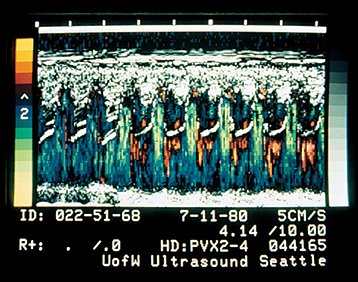
To make a long story short, I spent at least 20 years trying and failing to achieve the approval and recognition of my father. I thought my successes at university would be a breakthrough. Although I didn’t pursue a career in medicine (sick people and blood aren’t my cup of tea), I found I loved learning how things work and how to build things. For my Masters thesis in Electrical Engineering, I worked in the ultrasound department on an NIH grant and built the display portion of an ultrasound scanner. The image at the left was made in 1980 from this system. I was lead author on a 1981 paper in the journal Ultrasound in Medicine and Biology entitled Color digital echo/doppler image presentation describing the work.
On the day I brought my completed thesis home, I got barely any kind of response out of my father. Of course I was hoping for a heap of praise. When that didn’t come, in the pain of my disappointment I decided to make a radical change, choosing to relocate to a different part of the country and to quit trying to find my self-worth through the recognition I hoped to get from dad. In retrospect, I appreciate all my father did during his long life, especially in light of the fact that he grew up in a dysfunctional family environment (his father was an alcoholic, and at least some of the damage he received, in my view, remained unhealed).
Another 20 years were spent, in various ways, exploring my self-worth. Because I had grown up in a family environment where one must keep their thoughts and (especially) feelings to themselves, I had come to think that perhaps this was because I really had nothing of any value to contribute. In a work environment, I discovered that while I could have a normal one-on-one conversation with a colleague, I’d be become quite stressed if I had to speak to three or more people at the same time.
Here (again), a principle from A Course in Miracles was very beneficial to my healing:
I am here only to be truly helpful.
(ACIM, T-2.V-A.18:2-6)
I am here to represent Him Who sent me.
I do not have to worry about what to say or what to do, because He Who sent me will direct me.
I am content to be wherever He wishes, knowing He goes there with me.
I will be healed as I let Him teach me to heal.
When I focused on the fact that the reason I was speaking to a group was I was intending to be helpful, my anxiety decreased. I also recognized that the kind of people I really felt uncomfortable around were those who liked to be the center of attention (the narcissists), and I knew the reason I might want to hold the attention of others wasn’t for self-aggrandizement or egoic purposes.
A big turnaround for me happened when I realized I was much happier being alone than I was trying to fit into any social scene. Sitting after work in my big beanbag chair with my cat in my lap, listening to LP records on my headphones, was the perfect environment for me at that time in my life.