
Did the advanced forms of life we observe on our planet evolve at the beginning, step by step, from one-celled organisms all the way up to homo sapiens? Does Darwin’s proposition that “all species of life have descended from a common ancestor is now generally accepted and considered a fundamental concept in science” (quoted from Wikipedia) really make sense if you look closely at it?
When we look at the various forms of animals on Earth, we note that some fly, some inhabit the land, others can breathe underwater. Some live underground, others in trees. Some eat meat, others eat plants, still others plankton in the sea. Some have two legs, others four, others none (snakes, for example). Some life forms are very large (e.g. whales) while others are microscopic (bacteria, mites, etc.).
Some scientists do admit that natural selection is insufficient by itself to explain the development of animal body plans, for example the appearance in the evolutionary tree of an extra stomach or a pair of wings. But to question the dogma of natural selection is extremely challenging to evolutionary biologists because 1) no “purely scientific” explanation has been found to explain it and 2) any allowance of open discussion of an external agent that might be responsible for some aspect of the evolution of life is simply not allowed.
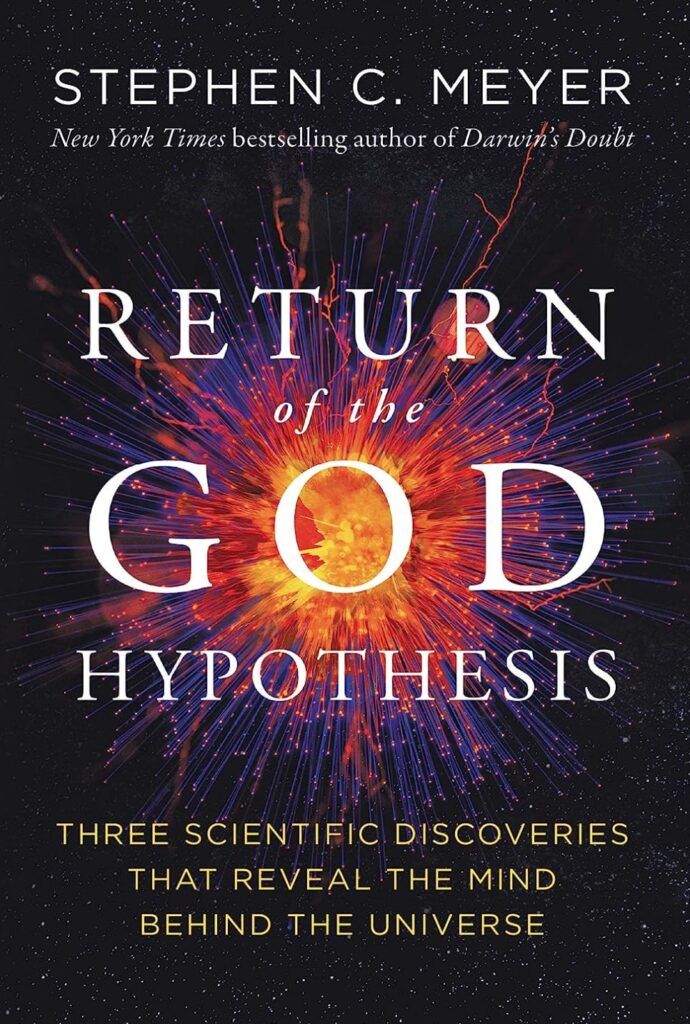
Return of the God Hypothesis by Stephen C. Meyer provides a scholarly argument in favor of Intelligent Design, e.g. the concept that some higher intelligent (mind) is responsible for the creation of what we see in our world. The word “God” in this context is like the “vast intelligence of the universe” that Eckart Tolle has referenced in his talks.
The book lays out three scientific discoveries that, in the author’s view, lead one to plausibly conclude that our physical world must be the product of a higher-level (otherworldly) creator. First, he lays out evidence from cosmology suggesting the material universe had a beginning (the “big bang”). Was this just an accident? Next, he outlines evidence from physics showing that from the beginning the universe has been “finely tuned” to allow for the possibility of life. That the the various observed natural physical constants, if any were to be different by even the slightest degree, life or the universe could not exist. Third, the author highlights evidence from biology establishing that since the beginning large amounts of new functional genetic information have arisen in our biosphere to make new forms of life possible.
Meyer asks us to consider the genetic code: the set of rules that define how DNA (based on a specific sequence of four nucleotide bases, adenine (A), cytosine (C), guanine (G) and thymine (T), encodes the process by which a cell can create amino acids, the basic building blocks of proteins. The genetic codes present in the gametes (ova and sperm) of male and female mammals define the entire structure of the offspring, including instructions for how it grows and evolves from fertilized egg into fully mature adult.
Meyer states that the function of DNA is determined by the nucleotide bases’ “arrangement is in accord with an independent symbol convention, later discovered and now known as the genetic code. And so what we have is a sophisticated information storage, transmission and processing system at the heart of every single cell.” Meyer goes on to say “DNA is like a software program, but much more complex than any we’ve ever devised.”
Meyer goes on to say: “What we know from our uniform and repeated experience, the basis of all scientific reasoning, is that whenever we find information, whether it’s in a section of software, or a paragraph in a book, or a hieroglyphic inscription, or even information embedded in a radio signal, and we trace that information back to its ultimate source, we always come to a mind, not a material process. The software program requires a programmer. The information in DNA, I argue, requires a master programmer.”
I agree! Though, when we think of a “programmer” we may envision a mega-intelligent super-being, which we would perhaps embellish with our imaginations as looking somewhat human-like. But what if instead of being in any way physical (even multi-dimensionally), what is involved here is an energy, or an organizing field, whose nature it is to turn chaos into order, sameness into diversity, discord into harmony, disconnection and separation into connection and unity, emptiness into the fullness of being? Sages and enlightened ones who say “God is Love” are on the right track.
When the organizing field evolves to a certain point, it can become self-aware. That’s a magical leap, but one we can experience first-hand has having happened.