Some things all new or prospective parents should know
Here are some general thoughts on being parents; some is based on personal experience growing up via a retrospective look at my own childhood:
- If at all possible, do as much of your “inner work” on yourselves as possible before your first child is brought into the family. The psychic wounds and traumas you carry will be transferred to your kids. Example: a way we deal with the unhealed wounds we carry is via projection: when triggered, we may try to blame and shame others.
- Make sure each of your kids gets the message daily, that you’re glad they’re here and that you love them very much.
- Involve them in the affairs of the family if you can. Explain what’s going on and let them know everything’s going to be OK even when you’re not sure it really is.
- Listen. Tune in to not only what they say, but the nonverbal cues that let you know they’re feeling something that they may not be expressing. Ask them what’s going on. Be a good friend and confidant. Let them know you care.
- Establish appropriate boundaries, and lead by example in boundary-setting.
- Shaming your child for any reason is never appropriate. See the section below featuring the wisdom of Brené Brown.
- Be kind. Make connection time, playtime, reading time, sharing time.
Vaccines
Please consider whether or not you want to enroll your newborn in the vaccination schedule being promoted by your pediatrician. What follows are a few facts that you may not be aware of that can help guide you in this decision.
The number of vaccines on the CDC’s immunization schedule has grown dramatically over the years. When I was young, children routinely received three vaccines, for protection against diphtheria, pertussis, tetanus, and smallpox, and as many as five shots by two years of age. According to the CDC’s current schedule, it is recommended that a child receive 26 shots by age two of ten different vaccines.
The schedule includes a Hepatitis-B shot at birth and two more in the first two months of life. Hepatitis is a relatively rare disease. Intravenous drug use and sexual intercourse are the most frequent routes of infection. You might wonder how a newborn would be at risk. Good question.
The turning point for the explosion in the number of vaccines on the recommended schedule came in the late 1980’s, when manufacturers appealed to congress, saying that lawsuits brought be people injured by vaccines had reached a point that their business was threatened. Congress responded with H.R. 5546—National Childhood Vaccine Injury Act of 1986. In accordance with this act, vaccine makers are absolved of liability for damages that might be caused by their products. If anyone feels that a vaccine has resulted in injury, they must take their case to the “vaccine court.” The National Vaccine Injury Compensation Program (VICP) allows someone who thinks they have been injured by a vaccine to seek compensation through the U.S. Court of Federal Claims.
Are these vaccines “safe and effective”? You may be interested to know that no study has ever been done to determine whether there is any detrimental health effect when a child’s body is asked to withstand so many injections in such a short time, when the body’s immune system is not fully developed. In fact, no study has ever been authorized by the US government (CDC, FDA, NIH) to look at health outcomes of vaccinated vs. unvaccinated children.
For American children born in 1986, per the NIH, only 12.8% had chronic diseases. That number has grown to 54% among those born after 1986, in lockstep with the ever-expanding vaccine schedule.
One courageous pediatrician, Dr. Paul Thomas, over the course of his practice, had provided parents with “informed consent” regarding vaccinations. On hearing the pros and cons, a fair percentage of parents in his practice decided not to vaccinate their kids at all. He thus had a large database with which to compare overall health outcomes of these vaccinated vs. unvaccinated cohorts. Dr. Thomas collaborated with researcher and scientist Dr. James Lyons-Weiler in analysis of patient data, and authored a paper entitled Relative Incidence of Office Visits and Cumulative
Rates of Billed Diagnoses Along the Axis of Vaccination, here:
Quoting from the abstract:
…it is notable that the overall rate of autism spectrum disorder (0.84%) in the [unvaccinated] cohort is half that of the US national rate (1.69%). The practice-wide rate of ADHD was roughly half of the national rate. The data indicate that unvaccinated children in the practice are not unhealthier than the vaccinated and indeed the overall results may indicate that the unvaccinated pediatric patients in this practice are healthier overall than the vaccinated.
When it comes to “trust your doctors,” in addition to recommending the Hepatitis-B shot, consider the vitamin-K shot. The CDC says here “Protect your newborn by making sure he or she gets the shot after birth.” It’s not likely they’ll show you the package insert for this product (e.g. provide “informed consent”). Here is a snapshot of the first few paragraphs:
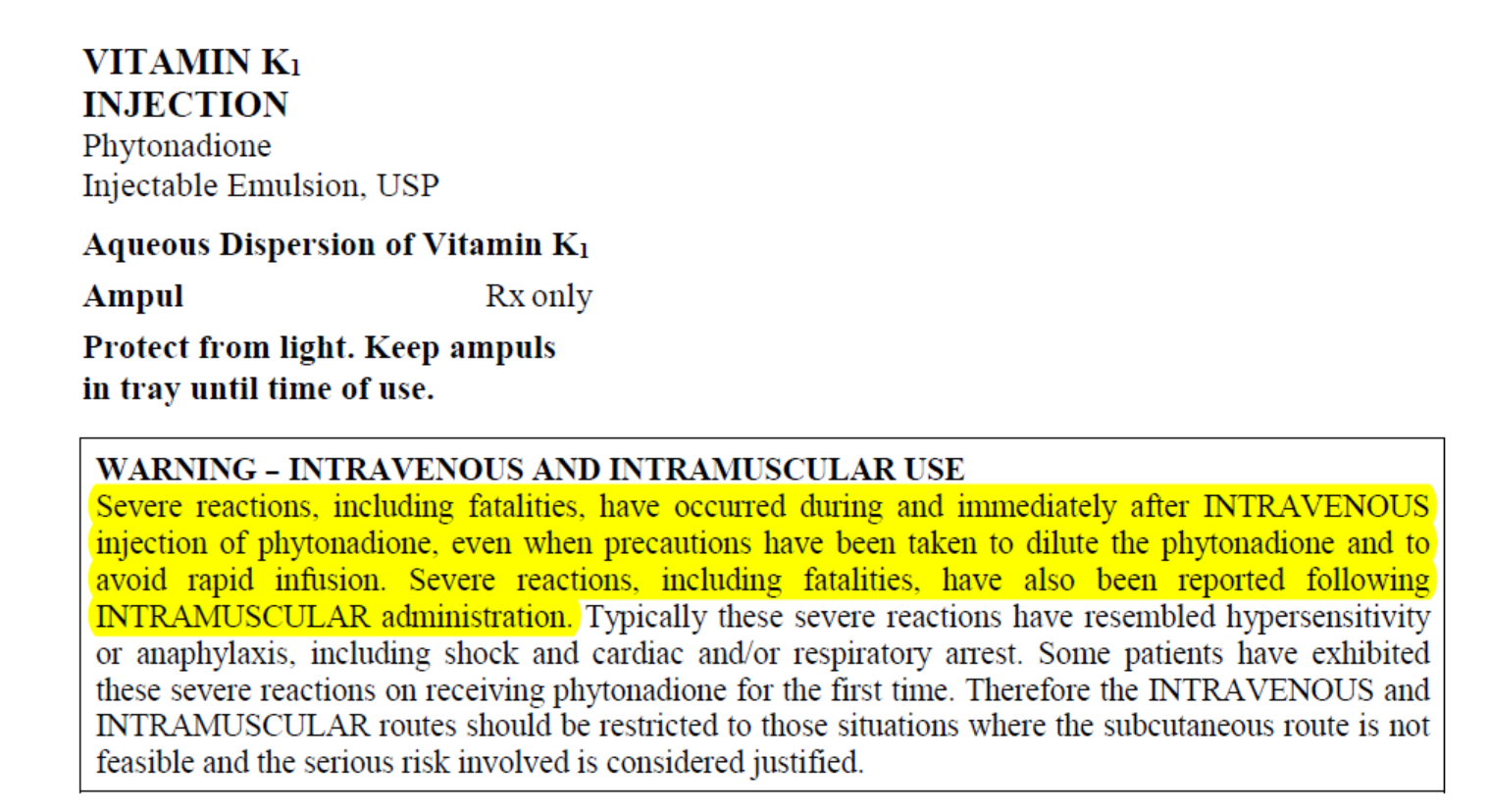
If the practices and policies in place in the United States were really effective, the rate of infant mortality in the US would not be as high as it is. According to the The American Journal of Managed Care, “The United States has the highest infant and maternal mortality rates out of any other high-income country and simultaneously spends the most on health care,” citing a 2023 report by the Commonwealth Fund here.
Shame
Kids as they grow up are extremely sensitive to feedback and input they receive from those around them, especially parents. If a child does something inappropriate, it is OK to tell the child “that behavior is bad,” but it can be very damaging to tell the child “you are bad.” It can be psychologically damaging to punish a child by embarrassing or ridiculing them.
I highly recommend all parents or prospective parents watch two Ted Talks by Brené Brown on this subject. The first one is entitled “The Power of Vulnerability.”
She says a child needs to feel connected, accepted, welcomed and appreciated. Shame is the fear of disconnection: “Is there something about me that, if other people know it or see it, that I won’t be worthy of connection?”
Brown links this shame to a belief that “I’m not good enough.” That there is something inherently wrong with me that I don’t know how to fix, that must mean I don’t deserve the love, attention, and affection that my heart desires.
So, model for your children the courage to be imperfect. To have the compassion to be kind to yourself as well as to others. You’re lovable even though you’re not perfect, even if you don’t score 100% one every test, even if you make mistakes. You can learn from mistakes and become a better person from that experience.
This resonated with me personally. I came into the world at an inopportune time, as far as my young parents were concerned. Dad was engaged in a stressful internship in the ER at Seattle’s King County Hospital, two blocks from where we lived in a low-income housing development. This emergency room was the place where the police brought gunshot victims and people injured in serious motorcycle accidents. Crime was rampant in that neighborhood.
I wasn’t breastfed (missing some important bonding with mother, I think). And apparently, one of the customs of the day was to feed babies “on schedule,” regardless of whether they got hungry and cried in between scheduled feeding times. When I was in my 30’s I attended a week-long personal growth intensive that involved various exercises designed to enable access to long-buried emotional wounds. In one of those exercises I was able to reconnect with a deep feeling of abandonment and helplessness. Through the grief I was able to associate this with my infant self being hungry, clearly expressing that hunger with my cries, and being denied the nourishment I needed. Reliving it was, I think, cathartic—a helpful release of trapped energy.